In the dynamic business landscape of 2026, mastering Market Research Methods is the definitive way to bridge the gap between a product and its target audience. Market research is the systematic process of gathering and analyzing data about consumers, competitors, and the economic environment to make informed decisions. Businesses that fail to utilize these methods often struggle with stagnant growth and high failure rates. By leveraging a mix of traditional techniques and modern AI-driven tools, companies can uncover hidden opportunities, optimize their pricing strategies, and build lasting customer loyalty. This guide explores 20 essential methods to ensure your brand remains competitive and data-driven.
What are Market Research Methods?
Market research methods are the specific tools and processes used by organizations to collect information about their target market. These techniques provide a structured way to understand consumer needs, evaluate competition, and identify industry trends. In 2026, these methods have evolved from basic surveys to complex data ecosystems. They allow businesses to move away from assumptions and base their strategies on verified evidence. Whether you are launching a new product or refining an existing service, using the right research methodology ensures that your resources are allocated efficiently and that your marketing message resonates with the right people at the right time.
Top Market Research Tools 2026
| Tool Name | Specialization | Best For |
| Google Trends | Search volume data | Market demand analysis |
| SurveyMonkey | Online Questionnaires | Quantitative feedback |
| Helium 10 | Amazon marketplace | E-commerce sellers |
| Hotjar | Behavior tracking | Website optimization |
| Brandwatch | Social listening | Sentiment analysis |
What are the 4 Types of Market Research Methods?
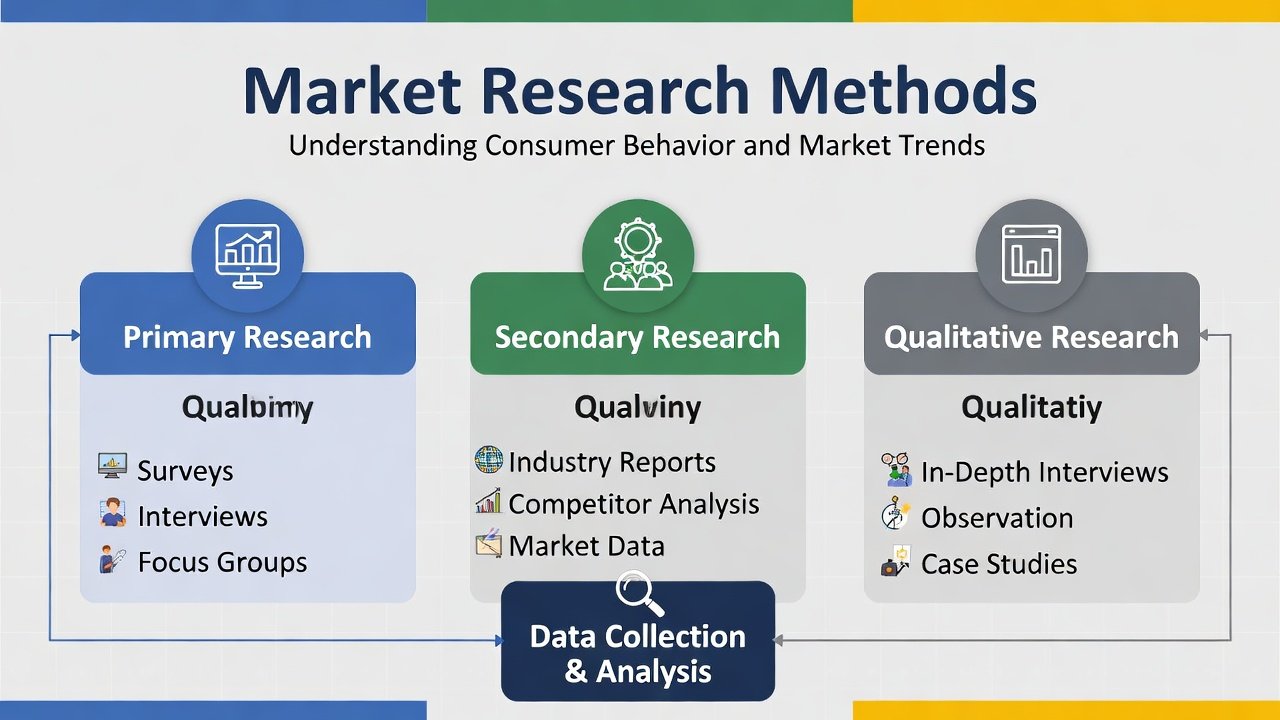
The industry typically categorizes research into four core pillars: Primary, Secondary, Qualitative, and Quantitative. Primary research involves gathering fresh data directly from sources, while secondary research utilizes existing information like reports and journals. Qualitative research focuses on the “why” behind consumer behavior through open-ended conversations, whereas quantitative research deals with numerical data and statistical patterns. Together, these four types create a comprehensive framework for analysis. Understanding how to balance these four pillars is essential for any researcher, as they each provide a different lens through which to view the market and validate business hypotheses effectively.
What is Primary Market Research Methods?
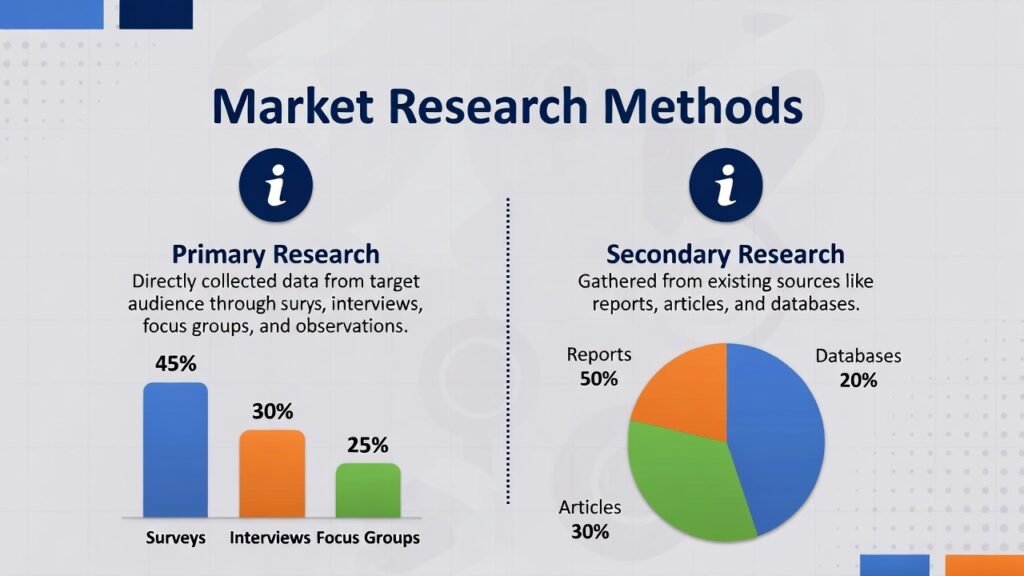
Primary market research methods involve the collection of original data that does not yet exist. This is “first-hand” information tailored specifically to your business’s needs. Common techniques include conducting live interviews, distributing custom surveys, or running focus groups. The primary advantage here is exclusivity; since you own the data, your competitors cannot access it. In 2026, primary research often includes real-time digital feedback loops. While this method can be more expensive and time-consuming than using pre-existing data, the specificity and relevance it provides are unmatched, making it the gold standard for high-stakes decision-making and product innovation.
Secondary Market Research Methods Explained
Secondary market research involves analyzing data that has already been compiled by third parties, such as government agencies, trade associations, or media outlets. This “desk research” is highly cost-effective and provides a broad overview of industry benchmarks and historical trends. In the modern era, secondary research is often the first step in any project, helping teams to define the scope of their primary studies. By reviewing white papers, census data, and financial audits, a business can understand the macro-economic factors at play. However, it is vital to ensure that the source is credible and the data is not outdated.
Qualitative Market Research Methods for Depth
Qualitative methods are designed to explore the human side of commerce. They focus on gathering non-numerical feedback to understand emotions, motivations, and perceptions. Methods like focus groups and in-depth interviews allow researchers to ask “probing” questions that reveal the nuances of a customer’s journey. In 2026, qualitative research has been enhanced by sentiment analysis AI, which can decode the tone and intent of spoken or written words. This methodology is particularly useful during the ideation phase, helping brands build a persona and craft marketing narratives that connect with the audience on a psychological and emotional level.
Quantitative Market Research Methods for Scale
Quantitative research is all about the “hard numbers.” It uses mathematical and statistical modeling to measure market size, identify trends, and validate theories across large populations. Standardized surveys, polls, and web analytics are the primary tools used here. This method provides objective data that can be easily visualized in charts and tables. In 2026, quantitative research is often automated, with AI processing millions of data points to provide instant KPIs. It is essential for determining market share, calculating potential ROI, and making scaling decisions. Because it relies on large sample sizes, the results are generally considered more reliable for generalization.
Online Market Research Methods in 2026
Online research has become the dominant form of data collection due to its speed and reach. Modern online methods include web-based surveys, social media polling, and digital “clickstream” analysis. Businesses can now reach thousands of global participants in a matter of hours. Interactive dashboards allow researchers to watch data come in real-time, adjusting their strategies on the fly. Furthermore, online forums and communities serve as constant focus groups where brands can observe organic discussions. The integration of mobile-first design ensures that surveys are accessible on smartphones, which is where the majority of modern consumers interact with digital content.
B2B Market Research Methods
Business-to-Business (B2B) research requires a different approach than consumer research because the sales cycle is longer and involves multiple stakeholders. B2B methods focus on professional pain points, technical requirements, and long-term ROI. In-depth interviews with industry experts and “lead-user” analysis are common techniques. In 2026, B2B researchers also utilize LinkedIn data and professional trade forums to track shifts in corporate demand. Understanding the decision-making unit (DMU) within a company is critical. This research helps B2B firms tailor their white papers, case studies, and sales pitches to address the specific logical and financial concerns of corporate buyers.
Amazon Market Research Methods for Sellers
For e-commerce entrepreneurs, Amazon-specific research is a specialized niche. It involves analyzing “Best Seller” rankings, keyword search volumes, and competitor review data. Tools like Helium 10 or Jungle Scout provide 2026 sellers with deep insights into “niche gaps”—products that have high demand but low-quality competition. Analyzing the “Frequently Bought Together” section helps in understanding cross-selling opportunities. Amazon research also focuses heavily on “review mining,” where sellers read negative reviews of competitors to identify features that customers are missing. This data-driven approach allows sellers to optimize their listings and advertising spend for maximum conversion within the world’s largest marketplace.
Market Research Methods for Small Businesses
Small businesses often have limited budgets, making cost-effective methods a priority. The best market research methods for small businesses include using free tools like Google Trends, social media analytics, and direct customer feedback. Simple email surveys sent to a loyal customer base can provide actionable insights for very little cost. Small owners can also perform “guerrilla research” by observing local competitors and talking to patrons in person. In 2026, community-based polling on platforms like Instagram or Facebook has become a vital tool for small shops to test new ideas or product colors before investing in inventory.
Market Research Methods for Startups
Startups operate in environments of extreme uncertainty, necessitating “Lean Research” methods. The goal is to validate the “Minimum Viable Product” (MVP) as quickly as possible. Startups often use A/B testing on landing pages to see which value proposition gets the most sign-ups. Rapid prototyping and “user testing” sessions are also critical to ensure the product solves a real problem. In 2026, startups use AI to simulate market conditions and predict customer churn. By staying agile and focusing on iterative feedback, startups can pivot their business models based on actual user data rather than sticking to a flawed original plan.
Innovative Market Research Methods
Innovation in research is currently driven by neuro-marketing and bio-feedback. These methods measure physical responses like eye movement, heart rate, and brain activity to gauge a consumer’s true reaction to an ad or product. Unlike surveys, these bio-metrics cannot be faked. Additionally, “Predictive Markets” are being used, where participants “bet” on the success of a product, providing surprisingly accurate forecasts. In 2026, VR (Virtual Reality) is used to simulate shopping environments, allowing brands to test shelf placement and store layouts digitally. These cutting-edge techniques provide a level of subconscious insight that traditional questioning simply cannot reach.
Comparison of Core Market Research Methods
| Method Type | Primary Goal | Cost | Speed |
| Surveys | Generalize trends | Low | Fast |
| Interviews | Deep individual insight | High | Slow |
| A/B Testing | Optimization | Low | Real-time |
| Focus Groups | Concept validation | Medium | Moderate |
| Secondary | Industry context | Minimal | Instant |
Effective Market Research Methods for Branding
To build a strong brand, research must focus on brand awareness, recall, and sentiment. “Brand Tracking” studies are conducted over long periods to see how public perception shifts after a marketing campaign. Narrative research is also used to see what stories consumers tell about a brand. In 2026, effective branding research involves monitoring “earned media” and social mentions to see if the brand’s values align with its audience’s. This helps companies adjust their messaging to ensure they are seen as authentic and trustworthy. Without this research, brands risk becoming out of touch with social trends and consumer expectations.
CATI Market Research Methods
Computer Assisted Telephone Interviewing (CATI) remains a vital tool for reaching specific demographics that might not be active online, such as the elderly or certain rural populations. CATI uses a software-driven script that guides a live interviewer through the conversation, ensuring consistency and accurate data entry. In 2026, CATI has been improved with AI voice-to-text features that analyze the caller’s sentiment in real-time. It is highly effective for complex surveys that require human clarification or for political polling where a personal touch is needed to ensure high-quality, verified responses from a specific geographic region.
Observational Research and Techniques
Observational research involves watching how people behave in their natural environment without direct interference. This “ethnographic” approach uncovers what people actually do, which is often different from what they say they do in surveys. Examples include heat-mapping in retail stores or “user session recordings” on a website. In 2026, AI-powered cameras can track dwell time and foot traffic patterns automatically. This method is excellent for identifying friction points in a customer’s experience. It provides authentic behavioral data that helps in optimizing physical layouts or digital interfaces for better usability and higher conversion rates.
Focus Groups: Traditional vs. Virtual
Focus groups bring together a small, diverse group of people to discuss a concept. While traditional focus groups happen in a physical room, 2026 has seen a massive shift toward “Virtual Focus Groups.” These use video conferencing and digital whiteboards to facilitate discussion across different time zones. They are more convenient for participants and cheaper for businesses. The moderator’s role is to ensure everyone speaks and to dig deeper into interesting comments. This method is perfect for testing creative assets like logos or TV commercials, where the group’s collective reaction provides a sense of how the broader public might respond.
Experimental Research and A/B Testing
Experimental research is a scientific approach where researchers manipulate one variable (like price or color) to measure its effect on another (like sales). The most common digital form is A/B testing. For example, an e-commerce site might show “Version A” of a button to half its users and “Version B” to the other half. In 2026, automated “Multivariate Testing” allows brands to test hundreds of combinations at once. This method provides clear, actionable proof of what works. It is purely quantitative and objective, making it the preferred method for “optimizing” existing digital products for maximum performance.
Market Research Methods and Techniques for Pricing
Pricing research is critical to ensure you aren’t leaving money on the table or scaring away customers. Techniques like the “Van Westendorp Price Sensitivity Meter” help determine the optimal price range by asking consumers at what point a product becomes too expensive or too cheap to be of quality. “Conjoint Analysis” is another powerful 2026 technique where users choose between different product bundles to see which features they value most and what they are willing to pay for them. This data-driven approach to pricing minimizes the risk of a failed launch and helps in maximizing overall profit margins.
The Best Market Research Methods for Global Expansion
When entering a new country, secondary research on local regulations and culture is the first step. However, primary research like “local focus groups” is essential to avoid cultural faux pas. In 2026, translation AI allows researchers to conduct surveys in dozens of languages simultaneously while maintaining the nuance of the questions. Understanding local competition and “buying power” is vital. Expansion research ensures that a brand’s value proposition is adapted to the local context. What works in New York might not work in Tokyo; therefore, “localization research” is the key to successfully scaling a brand globally.
Ethical Market Research Methods in 2026
Ethics in research has become a top priority due to strict data privacy laws like GDPR. Ethical research requires “informed consent,” where participants know exactly how their data will be used. It also involves “anonymization,” ensuring that individual identities are protected. In 2026, companies that are transparent about their research methods build more trust with their audience. Researchers must also be careful to avoid “bias” in their questions, ensuring that they aren’t leading participants to a specific answer. Ethical research is not just a legal requirement; it is a moral obligation that protects the integrity of the data and the reputation of the brand.
Conclusion
Successfully Understanding Market Research Methods is the only way to navigate the complexities of the 2026 global economy. As we have discussed, a balanced approach that combines primary and secondary data, as well as qualitative and quantitative insights, provides the most robust foundation for any business strategy. Whether you are a small business owner using free online tools or a global corporation utilizing neuro-marketing, the goal remains the same: to understand the customer better than they understand themselves. By committing to continuous research and ethical data collection, your business can stay ahead of the curve, minimize risks, and achieve sustainable growth in an ever-changing world.
Disclaimer: Information regarding Market Research Methods is for educational use only. While we prioritize 100% accuracy, market dynamics in 2026 fluctuate rapidly. This content does not constitute professional legal or financial advice. We assume no liability for strategic decisions or losses. Apply these insights at your own risk.
For More Information, visit cricksport.co.uk